
Wiki / WordPress and CMS
Warning: WordPress user list via the REST API
Anyone can open /wp-json/wp/v2/users and get the ID, display name and slug of every user who has published something, and the slug is normally the login name. No passwords or e-mail addresses are in there, so it is not urgent, but it hands a password guesser half of the login pair.
What it does not mean. It is not a WordPress bug: the project does not consider usernames private and keeps this address public on purpose. Nor does it mean the whole REST API should be closed: the line “/wp-json/ responds with HTTP 200” is normal for a WordPress site.
- In our report
- Warning (yellow); category “Publicly accessible sensitive paths”, weight 2.0 (the highest)
- Time to fix
- 10 minutes
- Can it break things
- Yes, if you close it for logged-in users too: the editor loses its author list
How to fix it
What we saw on a test WordPress 7.1.4: the fields id, name, url, description, link, slug, avatar_urls, meta. slug was the login with dots turned into hyphens (jonas.admin → jonas-admin), name equalled the login until another display name was set, and avatar_urls held the SHA-256 hash of the e-mail address. Users who had published nothing were not listed.
WordPress (tested on 7.1.4, PHP 8.4), file wp-content/mu-plugins/close-users-api.php
<?php
add_filter( 'rest_endpoints', function ( $endpoints ) {
    if ( is_user_logged_in() ) {
        return $endpoints;
    }
    unset( $endpoints['/wp/v2/users'] );
    unset( $endpoints['/wp/v2/users/(?P<id>[\d]+)'] );
    return $endpoints;
} );A visitor gets 404 rest_no_route at /wp-json/wp/v2/users, /users/1 and /?rest_route=/wp/v2/users; a logged-in editor (cookie and nonce) and an application password still get the list. The rest_endpoints filter has existed since WordPress 4.4.
nginx (tested on 1.26.3), in the `server` block
set $users_api 0;
if ($request_uri ~* "/wp-json/wp/v2/users|rest_route=(/|%2F)wp(/|%2F)v2(/|%2F)users") {
    set $users_api 1;
}
if ($http_cookie ~ "wordpress_logged_in_") {
    set $users_api 0;
}
if ($users_api) {
    return 404;
}Returned 404 for /wp-json/wp/v2/users, /users/1, ?rest_route=/wp/v2/users and its %2F form; /wp-json/ and /wp-json/wp/v2/posts stayed 200. The rule only checks that a wordpress_logged_in_ cookie is present, and anyone can send one, so use it together with the PHP snippet, not instead of it.
Apache (tested on 2.4.59), .htaccess above `# BEGIN WordPress`
RewriteEngine On
RewriteCond %{HTTP_COOKIE} !wordpress_logged_in_
RewriteCond %{REQUEST_URI} /wp-json/wp/v2/users [NC,OR]
RewriteCond %{QUERY_STRING} rest_route=(/|%2F)wp(/|%2F)v2(/|%2F)users [NC]
RewriteRule ^ - [R=404,L]Needs mod_rewrite. Same results and the same cookie caveat as nginx.
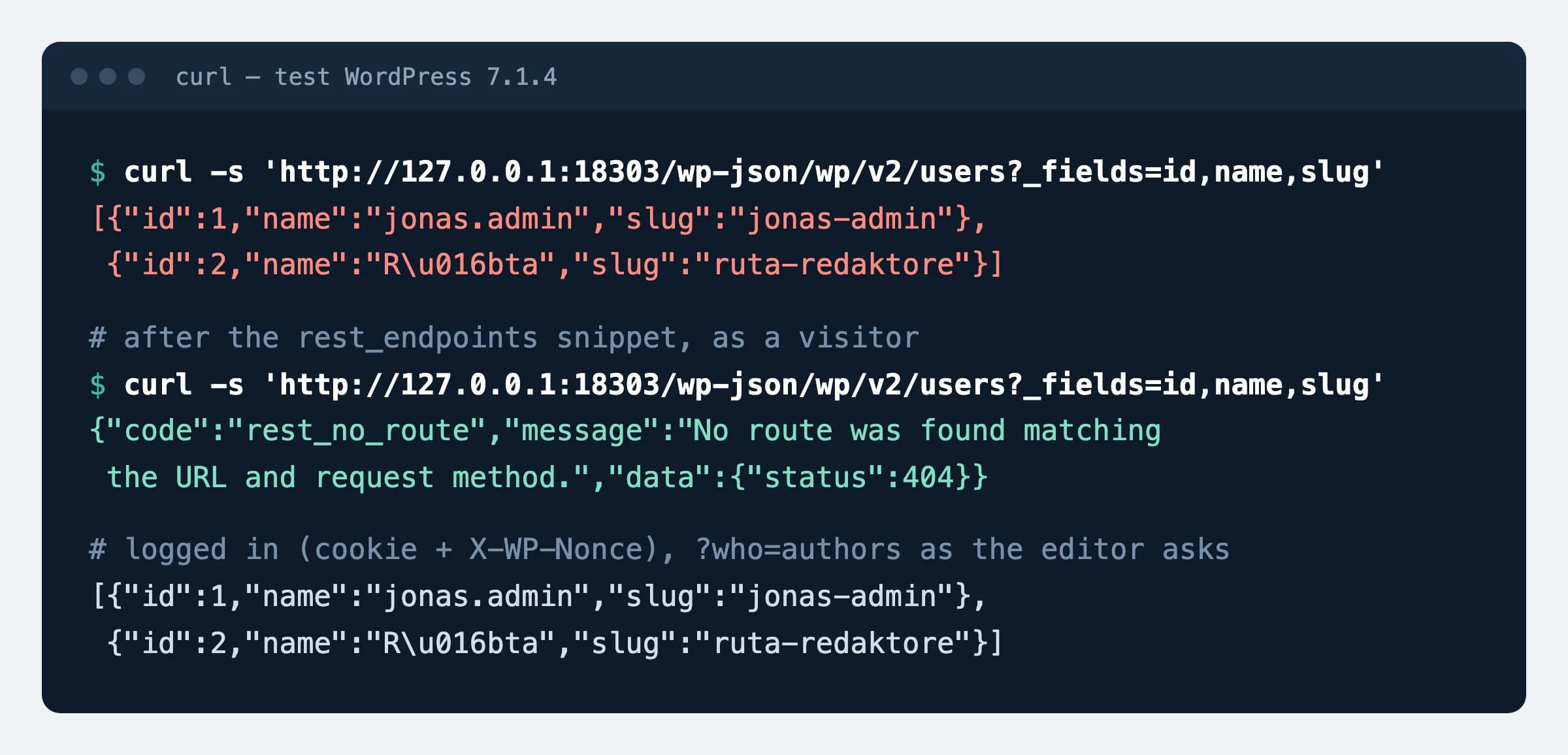
rest_endpoints snippet. The users are made up.How to check
curl -s -o /dev/null -w "%{http_code}\n" https://example.com/wp-json/wp/v2/usersExpected
404200 with a JSON list means the address is open; 401 means the whole API requires a login.
What can break
- Without the
is_user_logged_in()line the block editor loses its author picker: it requests/wp/v2/users?who=authors. - Visitor requests with
_embedget an error in place of the author:/wp/v2/posts?_embed=authorreturnedrest_no_routein_embedded.author. A headless front end or app that shows author names anonymously will lose them. - The server rules let requests through by cookie only: an app that signs in with an application password has no cookie and gets 404 from nginx or Apache.
- The login name shows up elsewhere too, for example through
/?author=1; that line has its own wiki page.
Possible values
How much to close: three routes, all tried on WordPress 7.1.4.
| What you do | What a visitor gets | When to choose it |
|---|---|---|
Close only /wp/v2/users (snippet above) | 404 for the user list, everything else works | Recommended |
Whole REST API for logged-in users only (rest_authentication_errors, snippet in the WordPress REST API FAQ) | 401 everywhere: /wp-json/, posts, oEmbed | Only if nothing on the site calls the API from the visitor's browser |
Close nothing, change the slug: wp user update 1 --user_nicename=redakcija --display_name="Redakcija" | The list stays but shows redakcija, not the login | When apps or a headless front end need the endpoint |
Our data
239
of 73,386 inspected .lt websites (0.33%) return a user list at this address. Dataset, 16 November 2026
Sources
- WordPress REST API: user schema and fields
- WordPress developer documentation: rest_endpoints filter
- WordPress REST API FAQ: disabling the API, requiring authentication
- WordPress security team: why usernames are not treated as secret
- nginx documentation: if and set
- Apache documentation: mod_rewrite
- AGuard: security dataset of Lithuanian websites, DOI 10.5281/zenodo.24282573
Changes
- Page published; PHP snippet tested on WordPress 7.1.4, nginx and Apache rules on a test server.