
Wiki / Email
Warning: SPF record
The domain does not publish which servers may send mail in its name, so a recipient's mail system cannot tell your server from a forger's. Since 1 February 2024 Gmail requires SPF or DKIM from every sender; the record takes 10 minutes.
What it does not mean. It does not mean your mail is already being rejected: if your messages are DKIM-signed, Gmail's requirement is met. SPF checks the technical sender address (MAIL FROM), not the one the reader sees, so on its own it does not stop forgery: that takes DMARC. We check only the domain itself; every subdomain needs its own record.
- In our report
- Warning (yellow), category weight 0.8 of 2.0. A record with
+all: risk (red) - Time to fix
- 10 minutes if you know every system that sends in your name
- Can it break things
- Yes: with
-all, mail from a sender you forgot fails the check
How to fix it
SPF is a single TXT record on the domain itself (name @): v=spf1, the list of senders, and a closing all. We evaluated every line below on 18 November 2026 with the SPF checker pyspf 2.0.14.
Your own mail server
@ TXT "v=spf1 ip4:198.51.100.7 -all"Replace 198.51.100.7 with your server's public IP address. ip4 and ip6 cost no DNS lookups.
Google Workspace
@ TXT "v=spf1 include:_spf.google.com ~all"The value from Google's documentation; Google recommends ~all. google.com publishes this same record.
Microsoft 365
@ TXT "v=spf1 include:spf.protection.outlook.com -all"The value from Microsoft's documentation; Microsoft recommends -all together with DKIM and DMARC.
Several senders: still one record
@ TXT "v=spf1 ip4:198.51.100.7 include:_spf.google.com -all"Take the include: value of a newsletter or invoicing service from its documentation and add it to the same record.
A domain that sends no mail
@ TXT "v=spf1 -all"Recommended by RFC 7208, section 10.1.2. This is what example.com publishes.
How to check
dig +short TXT example.com | grep spf1Expected
"v=spf1 -all"Exactly one line must come back. None: there is no record. Two: permerror.
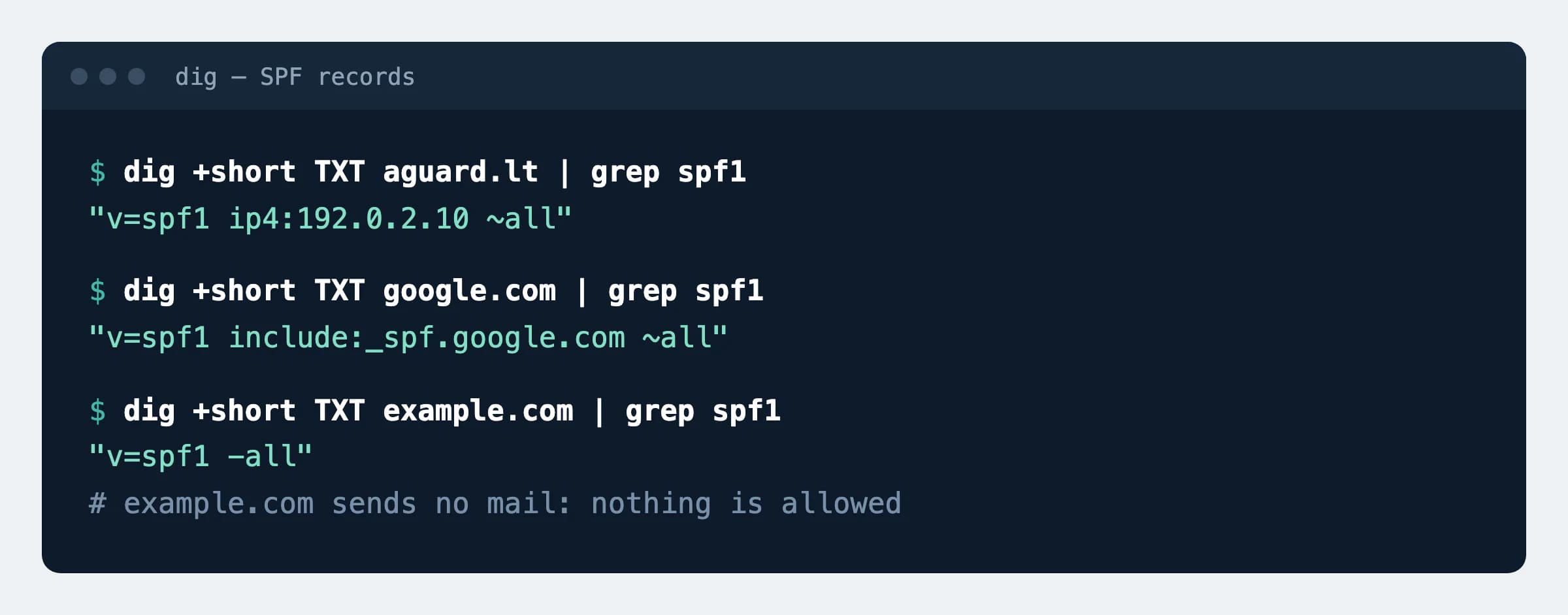
include: (google.com) and a domain that sends no mail (example.com). Our server's IP address is replaced with an example one.What can break
- Two
v=spf1records on the same domain producepermerror, and SPF stops working altogether. It usually happens when a second record is created for a new service instead of extending the first. - More than 10 DNS lookups (
include,a,mx,exists,redirect; nestedincludeterms count too) producepermerror. In our test 10includeterms still evaluated and 11 returned “Too many DNS lookups”._spf.google.comandspf.protection.outlook.comcost one lookup each today. - With
-all, mail fails from any system you left out: website forms on another server, a newsletter tool, invoicing software.
Possible values
The ending says what to do with servers that are not on the list. Rules from RFC 7208 (2014, current).
| Record | Result for an unlisted server | When to choose |
|---|---|---|
-all | fail: the server is not authorised | When the list of senders is complete |
~all | softfail: receivers should not reject on this alone | While you are still finding all senders; fine together with DMARC |
?all | neutral: treated exactly like a domain with no record | Never; a warning in our report |
no all | Same as ?all | Only when the record ends with redirect=: such a record is valid |
+all | pass: the whole internet is allowed | Never; a risk in our report |
ptr | A mechanism that checks reverse DNS | Obsolete: RFC 7208 (2014) says not to publish it |
DNS type SPF | A separate record type (99) | Removed by RFC 7208 (2014): publish TXT only |
Our data
13.4%
of 64,910 inspected .lt domains (8,685) have no SPF record. 86.6% (56,225) have one. Dataset, 16 November 2026
Sources
- RFC 7208: Sender Policy Framework (SPF), 2014
- Google: set up SPF for Google Workspace
- Microsoft: set up SPF for your Microsoft 365 domain
- Google: email sender guidelines
- AGuard: security dataset of Lithuanian websites, DOI 10.5281/zenodo.24282573
Changes
- Page published; rules checked against RFC 7208, `include:` values against Google's and Microsoft's documentation.