
Wiki / Reputation
Risk: Backscatter blocklist
Your mail server sent a non-delivery notice, an auto-reply or a sender verification probe to an address that never wrote to it, and hit a Backscatterer.org trap. The weight is modest: the list's own operator advises applying it only to bounce messages, not to ordinary mail. An entry lasts 4 weeks.
What it does not mean. This is not a list of spammers: the operator itself writes that ips.backscatterer.org “is NOT a spammerlist”. Nor does it mean the server is hacked or that your ordinary mail is being rejected. Which mail providers use the list is not published and we could not verify it; the list is run by UCEPROTECT.
- In our report
- Risk (red), category weight 0.8 of 2.0
- Time to fix
- The settings take minutes; an entry lasts 4 weeks under the list's policy
- Can it break things
- With forwarding off, mail no longer reaches the outside mailbox: add the mailbox to a mail app first
How to fix it
Backscatter appears when a server accepts a message and only later finds it cannot deliver it: the recipient does not exist, or the outside mailbox it forwards to (Gmail, for example) refused the spam. The non-delivery notice then goes to a forged sender. A well-configured server refuses during the SMTP session (550 User unknown) and sends nothing itself.
How many notices the server generated itself: Exim (tested on 4.97)
grep -c '<= <> R=' /var/log/exim4/mainlogA <= <> line with R= in the log marks a non-delivery notice the server created itself. If there are many and they go to strangers, look for mailboxes that forward to Gmail or Outlook: turn the forwarding off and read the mailbox in a mail app over IMAP, or filter spam before forwarding.
Postfix (default checked on 3.2.2)
postconf smtpd_reject_unlisted_recipient relay_recipient_mapsThe first parameter must be yes: it is the default since Postfix 2.1, and unknown recipients are refused during the session. The weak spot is domains the server only relays for: while relay_recipient_maps is empty, Postfix accepts mail for addresses that do not exist and returns it later. The Postfix documentation says to point the parameter at a table of valid addresses.
Exim (from the documentation; the line is in our 4.97 configuration)
require verify = recipientThe line belongs in the RCPT rules; exim -bP acl_smtp_rcpt shows their name. The default Exim configuration has it. If the rules contain verify = sender/callout, remove /callout: those are sender verification probes, which this list also lists for.
How to check
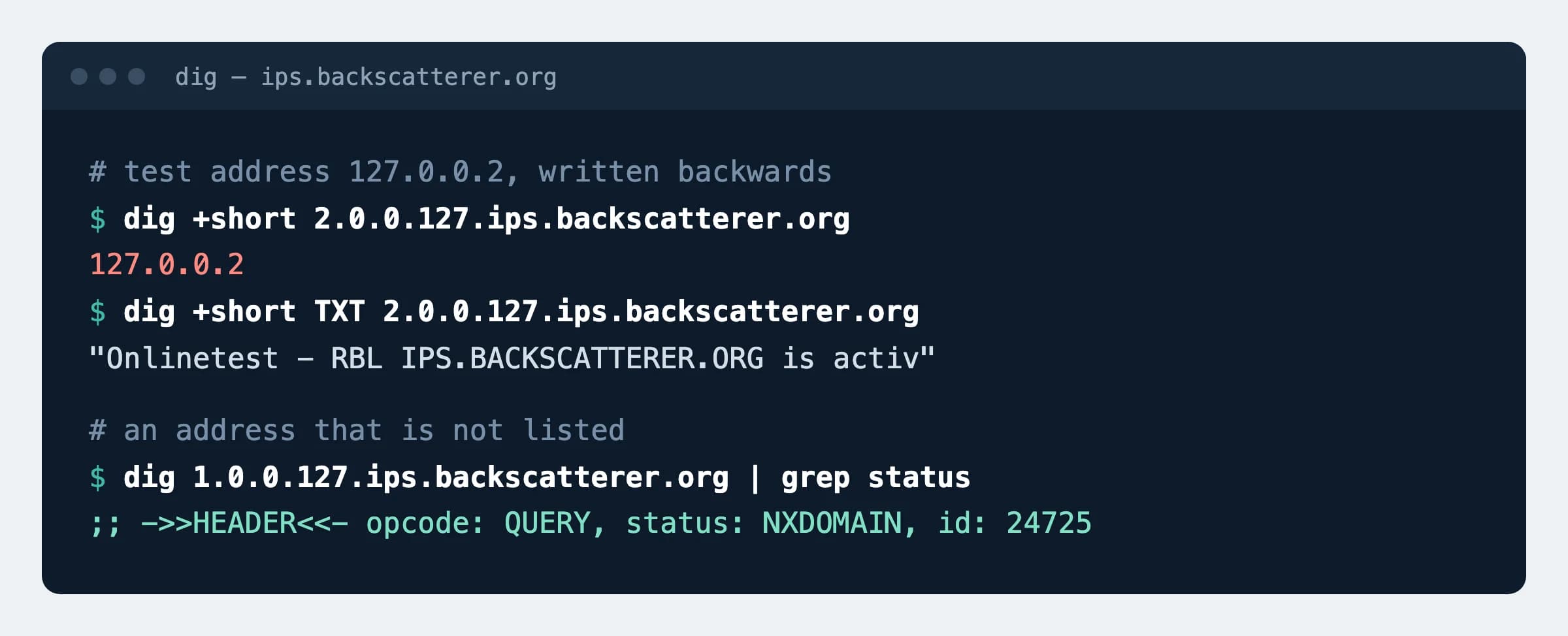
In the second query, replace 1.0.0.127 with your mail server's address written backwards.
dig +short 2.0.0.127.ips.backscatterer.org; dig +short 1.0.0.127.ips.backscatterer.orgExpected
127.0.0.2The single line belongs to the test address 127.0.0.2; nothing should follow it for your address. The list's website names no test address: RFC 5782 requires 127.0.0.2 in every IP list, and this zone answers for it. Unlike Spamhaus, it also answered through 8.8.8.8 and 1.1.1.1 in our test.
What can break
- Receivers that use the list in the “safe mode” the operator recommends consult it only when the sender is empty (
<>) orpostmaster. They will refuse your server's non-delivery notices and auto-replies, not ordinary mail. - A receiver that applies the list to all mail will refuse everything from your address. The operator itself advises against that, because large providers end up on the list too.
- We say nothing about early removal: on the list's website we found only the “4 weeks” rule and a lookup form.
Possible values
The three things that get an address listed, according to Backscatterer.org (checked on 18 November 2026).
| What | What it looks like | How to stop it |
|---|---|---|
| Misdirected bounce | A message is accepted, then returned to a forged sender | Refuse unknown recipients during the session; do not forward spam outside |
| Misdirected auto-reply | A holiday reply sent in answer to spam | Send auto-replies only after the spam filter |
| Sender callout | The server connects to someone else's server to test whether the sender address exists | Turn it off: /callout in Exim, reject_unverified_sender in Postfix |
Sources
- Backscatterer.org: listing policy (4 weeks)
- Backscatterer.org: usage and “safe mode”
- Backscatterer.org: misdirected bounces
- Backscatterer.org: sender callouts
- Postfix documentation: smtpd_reject_unlisted_recipient, relay_recipient_maps
- Exim documentation: the default configuration file
- RFC 5782: DNS blocklists (test entries)
Changes
- Page published; the list's rules read at backscatterer.org the same day, commands run on Postfix 3.2.2 and Exim 4.97.